Welcome to the Australian College
of Kahuna Sciences Accredited Bodywork Courses.
Kahuna Bodywork has been brought to the Western
World by (Kahu) Abraham Kawai’i, Kahuna (Kanaka Maoli).
The teaching is preserved and taught in Australia at the Australian
College of Kahuna Sciences in its original format.
The
Kahuna Bodywork course accreditations
provide a benchmark for professionalism in Kahuna Bodywork
Training, a benchmark for Kahuna Bodywork as
a massage therapy and modality in the Western
World.
Kahuna
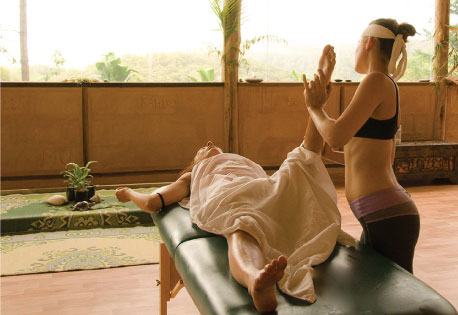
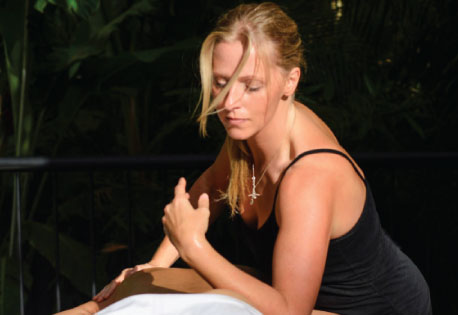
Bodywork is often mistakenly called Kahuna massage or lomi lomi.
It does incorporate elements of massage and lomi, but Kahuna
Bodywork is essentially much more. It requires the Kahuna exercises
to enable us to widen our understanding and ways of thinking,
to become able to 'read the script of a body', taking multiple
perspectives all at the same time. Only experience of the Kahuna
exercises can ever make us understand.
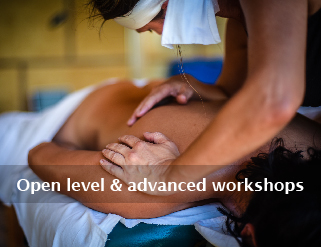
The Kahuna Bodywork courses extend to
Advanced Diploma level and were developed under the guidance
of the Kahuna, maintaining the Kahuna
style of training, incorporating the Family Principle
while complying
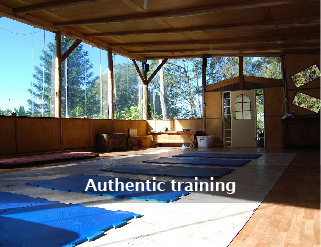
with Australian Qualification Standards. There is no other
authentic and accredited Kahuna Bodywork course.
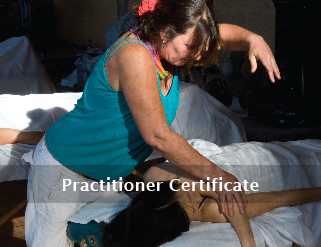
The College runs
personal development courses and workshops and 4 recognised
Kahuna Sciences Qualifications.
Flexible delivery
incorporates a variety of methods, including e-learning,
home studies, face to face classes, workshops,
and student clinics.
This flexible structure allows students
to take an active and constructive role in their own learning. Most
students decide to attend 2 practical workshops and 1 student
clinic per qualification, or per year. The length of your
training depends on your commitment to home study.
Kahuna Bodywork comes from Hawaii, but by Principle
does not teach something Hawaiian. Instead it
teaches people
to access
their own
inherited genetic wisdom, their own genealogy.
It provides pathway access to physically, mentally
or
spiritually
unexplored areas
within the Self. The result of these explorations
is multilevel and can be subtle or foundationally
life
changing, for
both the giver and the receiver.
Everybody seeking accelerated personal development and insight
via the ancient pathway of Kahuna exercises is welcome to enrol
for the live-in workshop retreats conducted by the college. The
workshops are popular with people looking for 'more success,
less effort' in their lives. If no qualification in Kahuna Bodywork
is desired one can still walk away with a greater understanding
of one's Self and one's place in this Universe, empowered, revitalised
and more aligned, flexible and fit, with a greater capacity to
face all life situations.
A Kahuna Bodyworker is
always in training, regardless of certificate level or level
of personal and
professional achievement. There
is always more.
Foundation to Kahuna Bodywork
Training are the Kahuna Exercises (Ka’alele au) and
preparations as developed by (Kahu) Abraham Kawai’i,
Kahuna.
Students practice Ka’alele
au, which are precise variables of martial art style ancient
hula sequences, for many hours and days before Kahuna Bodywork
and massage training commences.
Ka’alele
au, with its controlled and focused movements conducted at various
speeds, looks similar to Tai Chi Chuan and is an ancient spiritual
dance/movement - the art of non verbal communication with all
things.
Ka’alele au is designed to coax
the Western psyche into the practical understanding of connectedness
to all things, of
fluidity
in motion, of presence, dignity, focal
point application, leverage, and positioning, non-intent
and of observer
participation.
In Australia, the traditional foundational Ka'alele
au performance is part of all nationally recognised Kahuna
Bodywork qualifications.
Acknowledgement:
The instructors of the Australian College
of Kahuna Sciences acknowledge (Kahu)
Abraham Kawai’i, Kahuna, as the
Source of Kahuna Sciences Training
in all its implications and applications
and thank Kahu
and Ho’okahi Ho’oulu of
Na Pua ‘Olohe for their
patience and understanding as teachers
in the Ancient Arts.
|